
Access Denied
IMPORTANT! If you’re a store owner, please make sure you have Customer accounts enabled in your Store Admin, as you have customer based locks set up with EasyLockdown app. Enable Customer Accounts
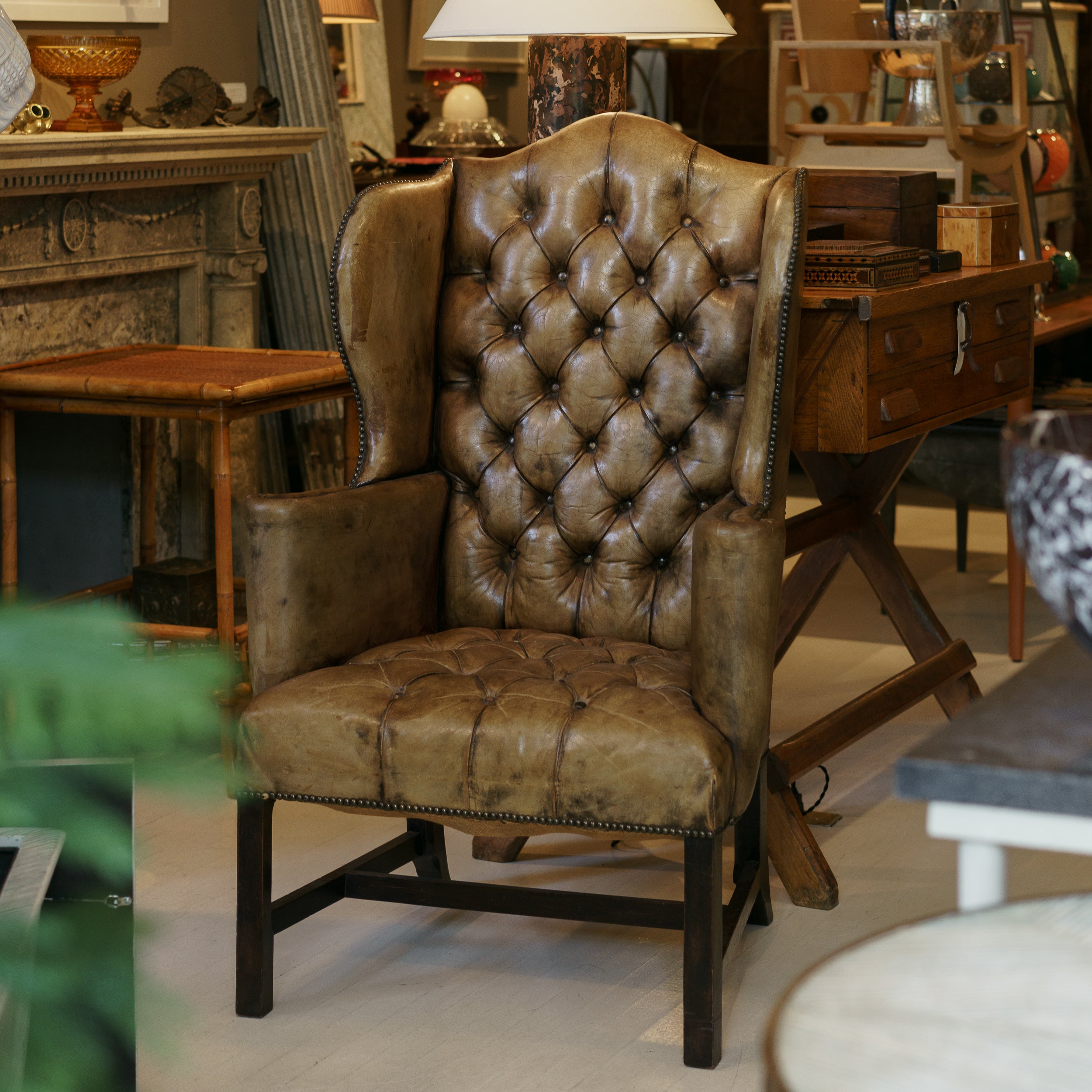
19th C. English Georgian Leather Wingback Chair
Deep button-tufting across the back and seat, wide wings, straight tapered legs joined by a turned stretcher. The frame is English Georgian, dating to the early 1820s, though the leather is later, reupholstered around the 1940s in a tobacco brown that's worn soft and cracked at the arms. A club-height library chair, built for regular use.
The wingback form developed in England in the early 18th century, the projecting side panels originally meant to shield a seated occupant from drafts and the heat of an open fire, a practical function that outlasted its original purpose and became a defining silhouette of English domestic furniture. By the Georgian period, wingback chairs had settled into their now-familiar library and study role, upholstered rather than caned, and built low and deep enough for long reading. Reupholstering a frame this age in leather decades after its construction, as happened here in the 1940s, was standard practice rather than a compromise. Frames were expected to outlast several rounds of covering.
Style: English Georgian
Materials & Techniques: Carved wood frame, tobacco leather upholstery, deep button tufting, nailhead trim
Place of Origin: England
Period: Frame c. 1820; leather reupholstered c. 1940s
Dimensions
49" H x 25.5" D x 31" W
19th C. English Georgian Leather Wingback Chair
Sale price$4,850.00
Regular price
Choose options
19th C. English Georgian Leather Wingback Chair
Sale price$4,850.00
Regular price
Invalid password
Enter